
Tech elites think prediction markets are the future of finance, so we surveyed thousands of college students across 483 campuses to test their theory.
Welcome to The Fizz Report.
I’m Teddy Solomon, Co-Founder & CEO of Fizz: America’s biggest college social app.
I’ve spent virtually my entire adult life on college campuses. On Fizz’s path to becoming the most popular college social platform since Facebook, I’ve visited nearly 300 universities and talked to tens of thousands of students.
These days, I’m 24 years old (1 foot in the grave), Fizz has raised >$40M, and students across nearly a thousand campuses use Fizz for everything from finding parties, to buying and selling clothes and concert tickets, to making friends.
Because of this, I get asked about Gen Z constantly.
From VCs.
From founders.
From marketers.
From journalists who believe Gen Z is either saving democracy or destroying society.
Everyone seems to have a theory about what young people think, so we decided to just ask them.
This is the first edition of The Fizz Report, where we attempt to democratize Gen Z by surveying the biggest community of college students in America. Today’s topic: Prediction Markets.
Prediction markets are having a moment. Over the past two years, prediction markets, or the ability to bet on virtually anything, have exploded. Platforms like Kalshi and Polymarket have reached $10B+ valuations, fought regulators in court, and built marketplaces where 18-year-olds in all 50 states can trade “event contracts” on things like:
- whether the Lobos will win tonight’s game
- whether inflation goes up
- whether President Trump says “fake news” during the State of the Union
Naturally, tech elites on Twitter have become very excited about this (event contracts yay!). Over the past year, I’ve had founders, VCs, and marketing execs alike ask me the same question: “Does everyone in Gen Z use prediction markets?” Initially, I laugh and say no, but then I remember I’m now an elderly 24-year-old, so I figured I’d go straight to the source.
For the first edition of The Fizz Report, we surveyed over 2,000 college students across 483 US campuses, representing 43 states…here’s what we found.
Prediction markets are not mainstream.
I hate to alarm those of you who are dangerously deep inside the SF/NYC tech bubble, but they’re not.
Despite all the hype:
- 30% of students have no idea what prediction markets are
- Only 12% have ever placed a bet on Kalshi or Polymarket
In other words, 88% of college students have never touched “the future of finance.”
That said, most students have at least heard of prediction markets, so we dug deeper.
College students think prediction markets are gambling.
Of the students who have heard of prediction markets, 75% say they consider them gambling.
It’s not entirely clear how college students arrived at this conclusion.
Perhaps it’s because:
- a huge portion of trading volume is sports
- the experience looks identical to an online sportsbook
- and the outcome is literally whether a team wins and how much they win by
But instead of calling it a bet, you call it an “event contract.” Checkmate, regulators.
Young people like gambling.
Here’s where things get interesting. Even though 75% say prediction markets are gambling, 84% of those same students say they should not be banned. Effectively, college students believe prediction markets are gambling, but they just don’t care. The data suggests that the real driver for the rise of prediction markets isn’t some newfound enthusiasm for financial forecasting…young people just really like to gamble.
So we dug even deeper into the data and the story became even clearer.
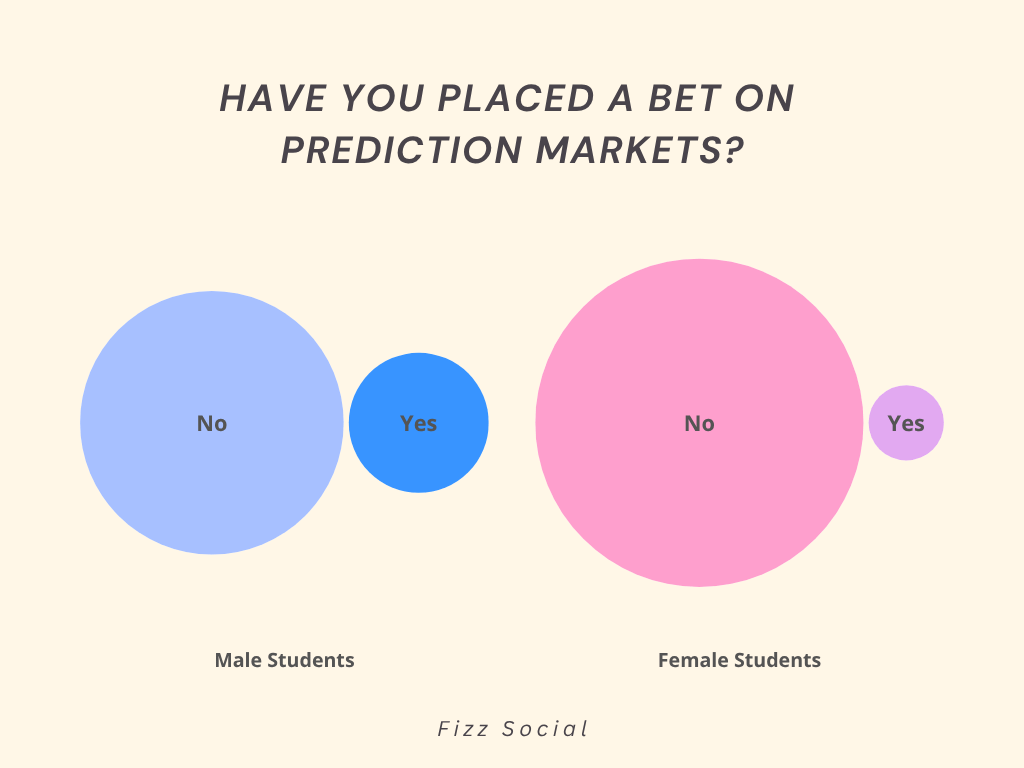
First, the gender dynamics are almost identical to those of online sports betting.
22% of men surveyed have placed a bet on Kalshi or Polymarket, compared to just 5% of women, suggesting that young men are more than 4X more likely to use prediction markets than young women. If prediction markets were truly a generational new financial tool, you’d expect usage to look more like stock trading apps or other fintech products.
Beyond pure usage, the awareness stats are also fascinating. Among female students, 38% have no idea what prediction markets are, in contrast to just 18% of men. This suggests that the current growth of prediction markets is being driven by a very specific niche audience, rather than broad mainstream adoption.
The people using prediction markets are already gamblers.
The strongest signal of all might be this: 31% of students say they bet on sports.
When we looked at which platforms those students use, we saw something interesting.
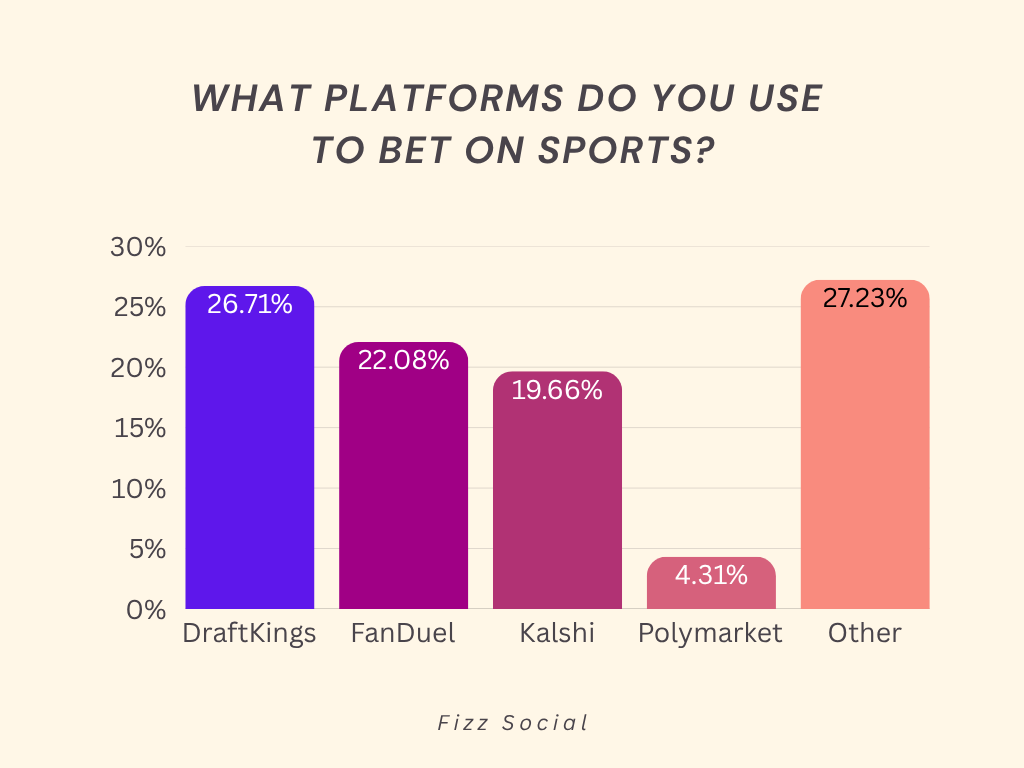
Among sports bettors:
- DraftKings: 27%
- FanDuel: 22%
- Kalshi: 20%
In other words, Kalshi is already nearly as popular as FanDuel among college students who gamble on sports. That’s not the adoption curve of a new financial instrument; that’s the adoption curve of a new sportsbook competitor.
Kalshi is 5X more popular than Polymarket.
Among students who use prediction markets, Kalshi is roughly five times more popular than Polymarket.
This likely reflects two things:
- Kalshi’s focus on sports markets (significant majority of Kalshi’s volume)
- The fact that it’s accessible in all 50 states
Which again reinforces the same theme: the demand isn’t for political forecasting or macro markets. The demand is for sports betting.
My conclusion: prediction markets are niche legal-arbitrage sports betting.
They’re not a revolutionary tool for price discovery.
They’re not parametric insurance.
They’re not the future of macro forecasting.
They’re gambling, just with slightly better vocabulary.
That’s it for the first edition of The Fizz Report.
If you’re working on products for Gen Z and want to ask thousands of college students a question, reach out to partnerships@fizzsocial.app. We might just include it in the next Fizz Report.
Interested in advertising on America’s biggest college social app? Click below to speak with our team.