
Welcome back to The Fizz Report, the newsletter where we explore all things Gen Z by going straight to the source: thousands of college students surveyed directly on Fizz, America’s biggest college social app.
For this edition of The Fizz Report, we set out to answer one of the biggest questions surrounding Gen Z commerce:
Does Gen Z really impulse-buy products on social?
We asked more than 6,800 college students across the Fizz network how they actually decide what to buy after social gets their attention. Here is what we found:
Social media still gets Gen Z to stop. But it does not always get them to buy. The real purchase decision happens outside of the feed: in comments, reviews, brand pages, and group chats. We call this the verification layer. It is where college students decide whether a product is real before deciding whether it is worth buying. For marketers, the new question is not just, “Where did Gen Z discover us?” It is, “What did they find when they checked?”
Full survey details are in the Methodology section at the end. Let’s jump in!
Social Gets the Discovery. Verification Gets the Sale.
TikTok and Instagram dominate social commerce discovery. 72% of students said the most recent thing they bought after seeing it on social was discovered on TikTok or Instagram. But the final step before purchase usually happened somewhere else.
When asked what they checked right before paying, only 13% said they “just bought it.” Nearly 9 in 10 students verified something first:
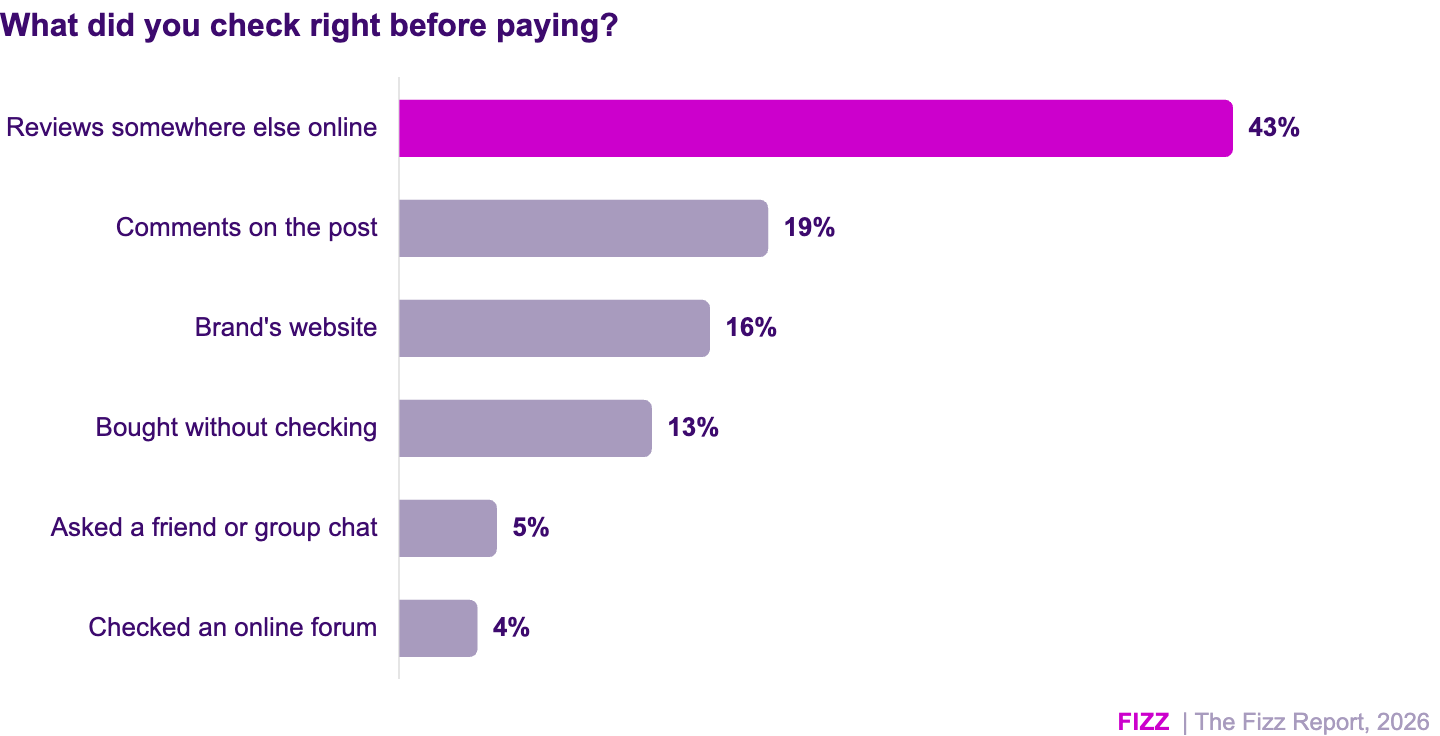
Social is not a self-contained purchase funnel. It is the starting point for a trust journey. Knowing where Gen Z discovers a product tells you how to get attention. Knowing where they verify it tells you how to actually close the sale.
Gen Z Does Not Buy Instantly. They Inspect.
One of the biggest myths about social commerce is that it is all impulse. That may alarm anyone building a media plan around Gen Z impulse buying, but the data says otherwise.
Only 12% of students say they typically buy a product the same day they first see it on social. And when thinking about the last thing they actually bought from social, only 5% purchased immediately. 60% spent at least 15 minutes checking first, and nearly 28% spent anywhere between an hour and multiple days before making the decision.
.jpg)
The social ad may create the spark, but students need multiple proof points before money moves.
The Comment Section Is Where Trust Is Built.
The strongest finding in this report is not about influencers, creators, or brand content. It is about comments.
When asked which scenario would most make them try or buy a product, the top answer was positive comments, chosen by 34% of students. That beat small creators, big creators, friends, classmates, and brand posts. Brand posts came in at just 2%. The content brands spend the most time and money polishing is often the least persuasive at the moment of purchase.
.jpg)
This does not mean brand content is irrelevant, but it has to trigger validation. A polished ad can create awareness, but a strong comment section creates permission to believe. Comments were also the second-most common final check before purchase, and 31% said real customers visible in comments would make them trust an unfamiliar brand enough to buy.
When comments are turned off, students notice. 92% read closed comments as a negative signal, assuming the brand is hiding something, the product probably gets complaints, or that it is a red or yellow flag. Only 8% said they don’t notice or don’t care. When comments are closed, students fill in the blank themselves. And what they imagine is usually worse than whatever the brand was trying to avoid.
Creators Still Matter, But Proof Matters More.
The creator economy has a trust problem. 35% of students said they trust creators less than they did two years ago. Another 30% said their trust is the same, but they are more aware of when creators are being paid. And they notice. Only 7% trust creators more.
That is a warning signal for influencer marketing, but not a death sentence. Students are not rejecting creators altogether. They are rejecting content that feels too scripted, too sponsored, or too obviously optimized.
Scale does not equal persuasion either. Small creator reviews and small creators using a product combined for 27% of “most likely to make me try or buy” responses. Big creators combined for 14%. That is nearly a 2x advantage for smaller, more relatable creators. The same pattern held when we asked what would make students trust an unfamiliar brand enough to buy:
.jpg)
The lesson is to stop treating creators as a replacement for proof. The best creator strategy makes the product feel more real, not more advertised.
A note for media planners
The biggest gender gap in the data showed up around creator scale. Men were more than 2.5x as likely as women (23.5% vs. 9.2%) to say a big creator with 1M+ followers using or reviewing a product would drive them to buy. Women leaned toward smaller, more personal signals: small creators, peer comments, and friend recommendations. The practical read: mega-influencer reach may land more efficiently with male college audiences, while smaller creators and visible peer proof resonate more broadly, especially with women.
Entertainment Stops the Scroll. Proof Closes the Sale.
Entertainment earns attention. When asked what made a brand post recently stop their scroll, the top answers were that it seemed genuinely useful (34%) or it was funny or entertaining (27%). But when asked which type of post is most likely to make them actually buy, the answer shifted to proof: detailed reviews led at 35%, ahead of discounts, funny posts, and creator promos.
.jpg)
.jpg)
The best Gen Z campaigns do not choose between being entertaining and being useful. They need both. Make the product worth watching, then make it easy to verify.
Fake Proof Is the Fastest Way to Lose the Sale.
Students are skeptical of more than ads. The top skepticism triggers were scripted creators (24%), fake or filtered comments (24%), too many sponsored posts (19%), and too many influencers (16%). Then we asked students to think about a time they wanted to buy something from social, but did not. The trust-related reasons were blunt:
.jpg)
Reviews that seemed fake and brands that could not be verified tied for the top spot at 22% each. Price was the only non-trust factor that competed, at 21%. Read that again: fake-looking proof kills more sales than price does.
This is the danger zone for brands. The same tactics designed to drive conversion can also poison verification: over-scripted creators, fake-looking comments, repeated ads, and closed comments. Beyond annoying students, they make the product feel less real.
Brands Can Recover Trust, But They Have to Act Like Humans.
Students do not expect brands to be perfect. They do expect them to be honest.
When asked what kind of brand reply to criticism would build trust, the top answers were accountability, not cleverness: fixing the problem publicly (38%) and an honest answer admitting the flaw (32%). A funny, self-aware reply came in at just 9%.
.jpg)
The playbook is simple: fix the problem, admit the flaw, explain clearly, and be visible. Do not hide criticism. Do not over-polish the response. For Gen Z, transparency is a conversion tactic.
The Group Chat Is Part of the Funnel.
70% of students have sent a product to a friend or group chat, and more than half have done it within the past month. Among students who shared a product, the top reasons were wanting a friend’s opinion before buying (37%) or thinking the friend would want it (35%).
The group chat is used for verification, co-signing, researching, roasting, and sometimes killing the sale. Brands do not need to “enter the group chat.” They need to create something worth being carried into it.
5 Takeaways for Marketers
If you market to Gen Z college students, here is what you can do with this data:
1) Build for verification, not just attention. A campaign that stops the scroll but fails verification is unfinished. Before launch, ask: after a student sees this, what will they find when they check? Make sure there is something real to find, and put it close to the point of discovery: visible reviews, an active comments section, a credible website.
2) Treat comments like a conversion surface. 92% of students read closed comments as a negative signal, and nearly 70% say a transparent response to criticism builds more trust than silence. Before launching, ask: if a student opens the comments, does this product look more credible or less credible?
3) Treat creator content as a reach tool, not a closing tool. Real customer proof and peer recommendations consistently outperform creator endorsement at the actual moment of purchase decision.
4) Make proof easy to find. Students are already checking reviews, websites, friends, forums, and other social platforms. Do not make them hunt for credibility. Put real customers, real reviews, real use cases, and clear product proof closer to the point of discovery.
5) Win the group chat indirectly. The best group-chat strategy is not forced virality. It is giving students something useful, funny, surprising, or genuinely worth asking a friend about.
The Bottom Line
Gen Z is not impossible to influence. They are just harder to fool.
They discover on social, but they buy after verification. They notice creators, but they trust visible customers. They like entertainment, but they still want proof. They may stop for the funny post, but they pay after the comments, reviews, and group chat clear the product for takeoff.
The brands that win with college students will not be the ones that shout the loudest in the feed. They will be the ones that still look credible after Gen Z checks.
That’s it for Edition 2 of The Fizz Report.
Want to turn these insights into action? Fizz helps brands reach college students at scale through high-impact native ads, branded surveys, ambassador recruitment, custom UGC, and live campus activations.
Have a question you want answered by thousands of verified college students? Email partnerships@fizz.social. We may include it in a future edition of The Fizz Report.
Methodology
This report draws on two surveys fielded across the Fizz network of verified college students in May and June of 2026. Survey 1 reached 1,749 students and covered creator trust, social content, and purchase drivers. Survey 2 reached 5,051 students and covered the specific behaviors that happen between social discovery and purchase. Combined, more than 6,800 student responses contributed to this report.
Findings on purchase timing habits, creator trust, try-or-buy scenarios, scroll-stopping content, and skepticism triggers come from Survey 1. Findings on discovery platforms, final checks before purchase, most recent purchase timing, unfamiliar brand trust, closed comments, brand responses to criticism, and group chat behavior come from Survey 2. Percentages are rounded and may not total 100.
About The Fizz Report
The Fizz Report is an ongoing research series from Fizz, the biggest college social app in the U.S., live at nearly 1,000 campuses. Each edition surveys our network of verified college students to surface real, current data on how Gen Z thinks, shops, and engages.
For advertising, media partnerships, or to collaborate on future editions of The Fizz Report, reach out to the Fizz Brand Solutions team: partnerships@fizz.social.