
If you could permanently ban AI tomorrow, would you? We asked college students that question, and 56% said yes. On its own, that's a striking number since 96% of college students use AI today. But the contradiction gets even more interesting when you look at the students who rely on AI the most. Among students who are super users, two-thirds say their schoolwork would become much harder without it, yet 1 in 5 would still make AI disappear tomorrow if they could.
Welcome back to The Fizz Report, where we don't assume to know what Gen Z thinks and instead ask them directly.
Every week, someone in tech exclaims that Gen Z is the "AI-native generation" that will grow up fluent in these tools and run circles around everyone else. So for this edition, we surveyed 5,282 college students across 791 U.S. campus communities to get their take about the impact of AI on their school, careers, and personal lives.
Here's what we found: Gen Z uses AI the way their grandparents smoked. They suspect it's bad for them; a majority would ban it if they could, but the heaviest users can barely imagine getting through school without it.
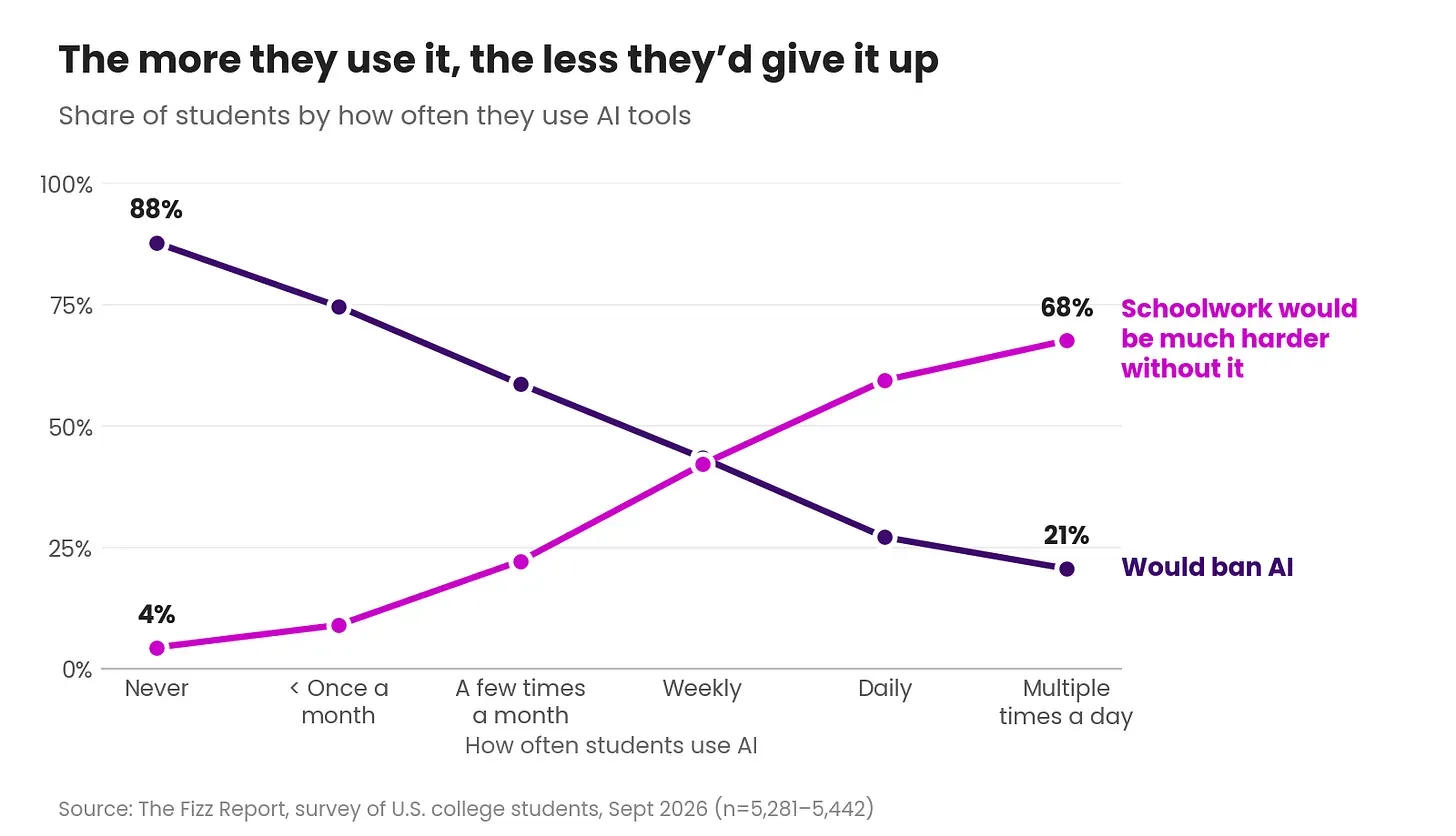
The heaviest users are hooked
The dependence curve in our data climbs almost perfectly with usage. Among students who use AI less than once a month, 9% say their schoolwork would become much harder if it disappeared. That rises to 22% among students who use it a few times a month, 42% among weekly users, 59% among daily users, and 68% among students who use it multiple times a day. That’s a 7x gap between the lightest and heaviest users, for a technology that has been widely available for about as long as it takes to finish a bachelor’s degree. Meanwhile, 1 in 5 students who never touch AI say their schoolwork would actually get easier if it disappeared. Apparently everyone else’s habit is their problem too.
And it's leaking well past homework. Among the heaviest users, 43% say preparing for their career would become much harder without AI, and 40% say the same about their day-to-day lives.
Nobody thinks it's making them better
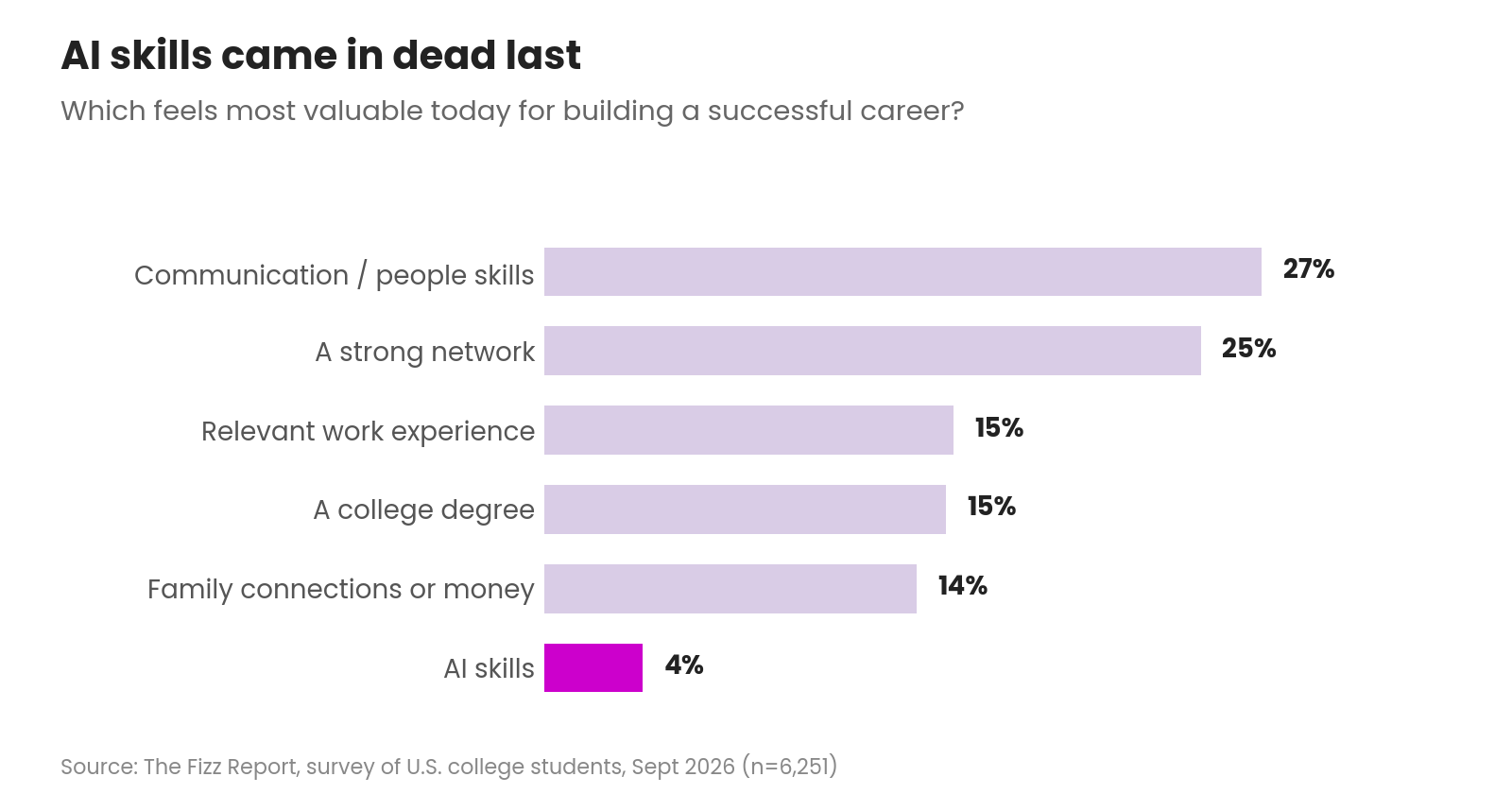
This is the part Silicon Valley may not love. We asked students to name the single most valuable thing for building a successful career, and AI skills came in dead last at 4%. Communication and people skills won at 27%, followed by a strong network at 25%. Even among students who use AI multiple times a day, only 8% picked AI skills. Sorry, prompt engineers.
So why are they using it so much? Because everyone else is. Nearly half of the heaviest users say they feel significant pressure to use AI because they're afraid of falling behind in the job market, compared with fewer than one in ten students who never use it. And the pressure isn’t only coming from recruiters: 64% of students feel at least some pressure to use AI because of their professors or school expectations. The pitch that AI will give Gen Z a superpower has landed with roughly 4% of Gen Z. Everyone else is using it for the same reason people lit up at parties in 1965: opting out felt worse than joining in.
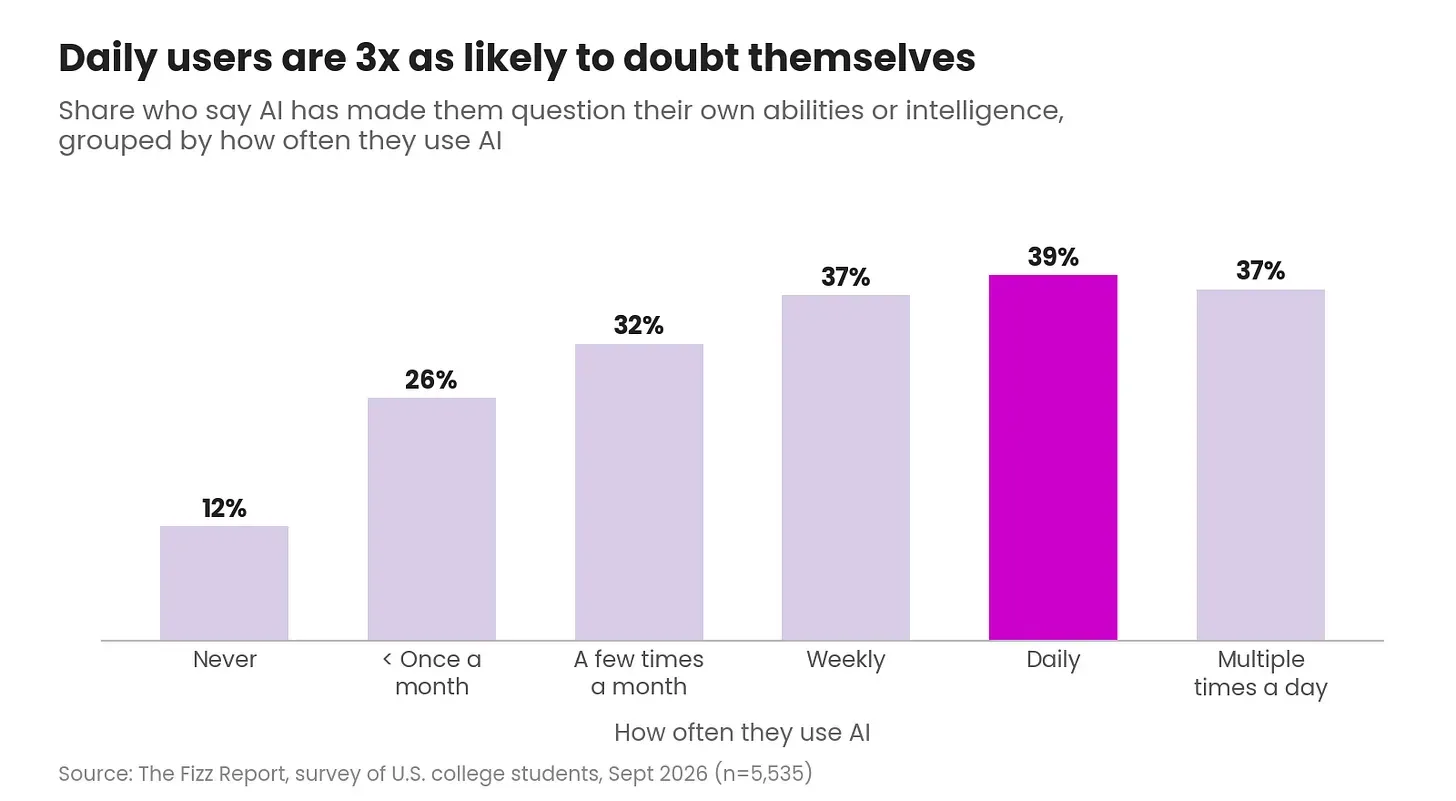
The self-doubt numbers are where this gets uncomfortable. Among students who never use AI, 12% say it has made them question their own abilities or intelligence. Among daily users, that jumps to 39%, more than three times higher. Yes, correlation, causation, we know, and it's entirely possible less confident students simply lean on AI harder. Either way, the students outsourcing the most thinking are also the least sure they can do it themselves, during the exact years they're supposed to be figuring that out.
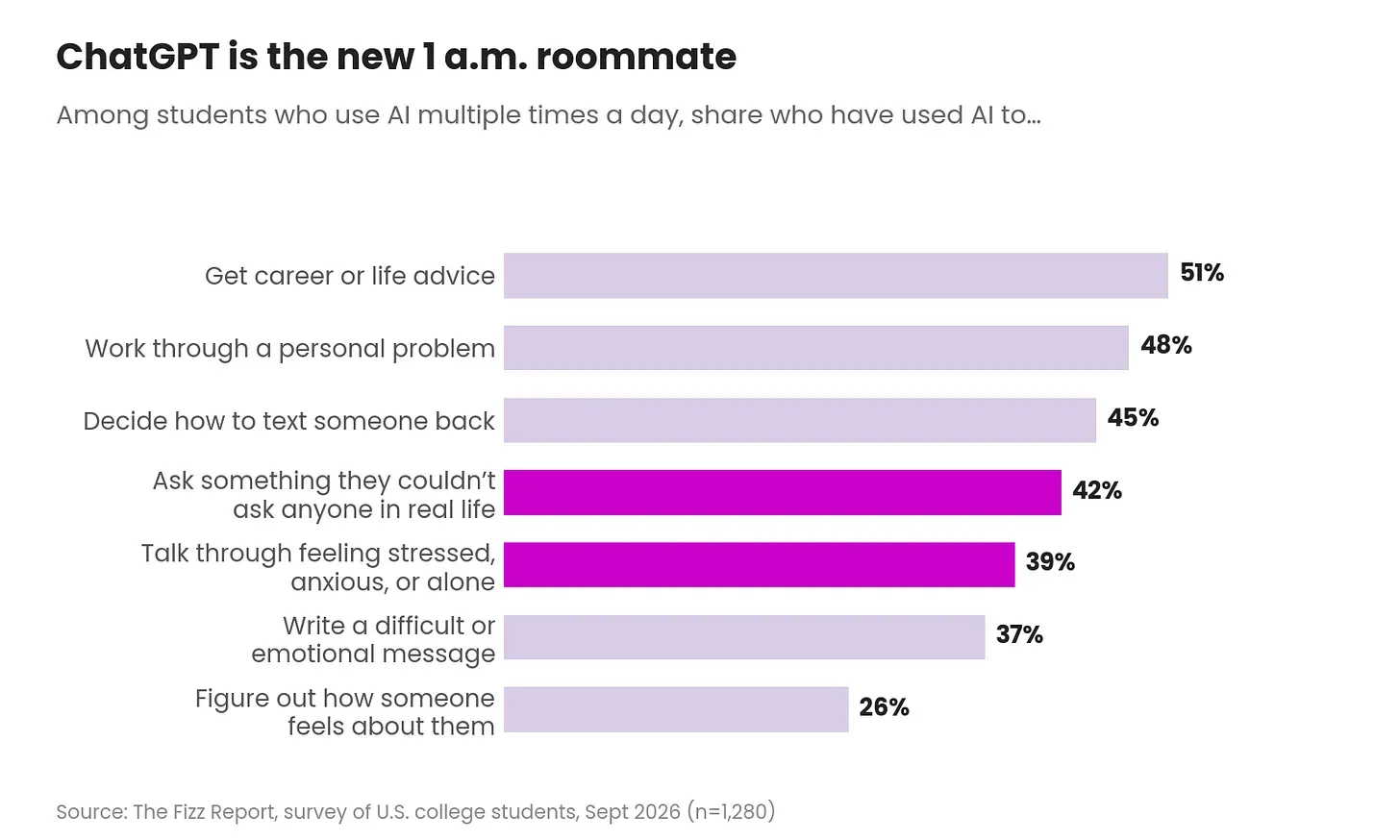
ChatGPT is the new 1 a.m. roommate
For the heaviest users, AI has moved out of the library and into their personal lives. Among daily users, 86% have used AI for something they otherwise might have talked through with another person. Among students who use it multiple times a day, 45% have asked it what to text someone back, 43% have asked it something they weren't comfortable asking anyone in real life, and 39% have turned to it while stressed, anxious, or alone.
Naturally, Gen Z has already invented rules for this. More than 90% say they'd be bothered by a romantic partner using AI to write messages to them or to make decisions about the relationship. The new dating etiquette on campus is extremely Gen Z: I can have ChatGPT write my texts, but if I find out you had ChatGPT write yours, we're done. Tolerance does build, though. The heaviest users are three times as likely as non-users to say neither would bother them (17% vs. 6%).
They're scared of the right things (just not the ones you'd expect)
When we asked students who want AI banned to explain why, the answer adults usually argue about, job loss, came in third at 11% of substantive responses. Cognitive decline and dependence came in second at 28%. The top reason was environmental damage and data centers at 35%. Politicians and CEOs are debating paychecks while students are worried about the planet and their own brains.
They're also remarkably optimistic about themselves specifically. Two-thirds of students (67%) expect AI to make economic inequality worse, while 84% are confident the jobs they're preparing for will still exist when they graduate. AI will wreck the economy for everyone except me, apparently.
Our conclusion: AI is Gen Z's cigarette
The comparison is closer than it sounds. A majority would ban it. The heaviest users would struggle to function without it. Their biggest fear is what it's doing to their minds. They reach for it when they're anxious or alone. And almost nobody believes it's actually making them better; they use it because everyone around them uses it, and quitting alone feels like falling behind.
The difference is that no one ever needed a Marlboro to finish a problem set, and no professor ever expected students to smoke. Silicon Valley believes it handed Gen Z a superpower. Gen Z would hand it back tomorrow, as long as everyone else did too.
Methodology
Fizz surveyed college students across 791 U.S. campus communities about how they use AI and its impact on their education, careers, and personal lives. The survey received 9,727 responses to its opening question, with response counts varying by question and 5,282 students completing the final question. Percentages throughout this report are calculated using the number of respondents who answered each question.
That's it for this edition of The Fizz Report.
Have a question you want answered by thousands of verified college students? Reach out to partnerships@fizz.social. We might include it in a future edition.